"LUCKY PEACH" FOOD JOURNAL HIGHLIGHTS JOYCE CHEN'S PEKING RAVIOLI
Wednesday, February 25, 2015
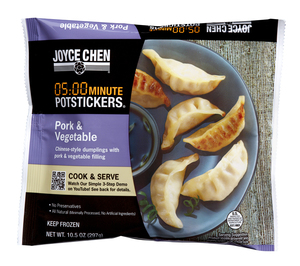
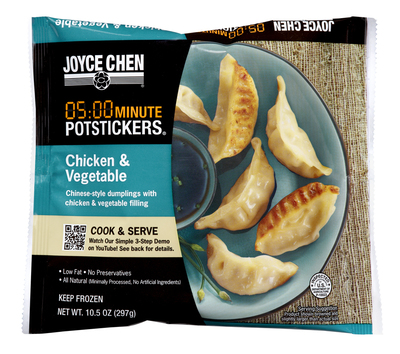
In case you haven't heard of Lucky Peach , here's the scoop. It's a quarterly food journal that was founded by New York's Momofuku chef David Chang (who was honored with a James Beard Award), Peter Meehan, cowriter of the Momofuku cookbook, and the producers of the CNN show, Anthony Bourdain: No Reservations . It's website describes it as, ". . . a melange of travelogue, essays, art, photography, and rants in a full-color, meticulously designed format. " Also, "Each issue will focus on a theme. . . " The theme for the February 25, 2015 issue is the DUMPLING! ! There are articles on what goes inside the dumpling and what's on the outside. There's history, recipes, an extensive guide to dumplings and almost dumplings, and critiques of a few of dumpling wrapping instructional videos. And, of course, there's an article about Joyce Chen and her Peking ravioli. According to Leah Mennies, who wrote "The Story of the Peking Dumpling," "To delve into (the name Peking Ravioli), though, is to get a glimpse of Boston’s culinary past. And as with much of the Chinese food in the area—from moo shu and Peking duck to scallion pancakes and the all-you-can-eat buffet—it all starts with Joyce Chen and her seminal Mandarin restaurant, Joyce Chen Restaurant, which she opened in Cambridge in 1958. " By interviewing Merry White, anthropology professor at Boston University, Mennies learned that in the 1960s when Joyce Chen popularized the phrase Peking ravioli, the term ravioli was better known by the Italian community in Boston than the general population. Also, the ravioli was building in popularity then. Chen succeeded in coining a lasting name for the dumpling (or potsticker) that expressed that the dumpling was a filled pouch, and that honored Beijing, her place of birth. Today, Joyce Chen Foods offers several types of frozen potstickers based on Joyce Chen's original recipes. Try our delicious 5-Minute potstickers (microwaveable) in chicken and vegetable, vegetable, and pork and vegetable, or our thicker skin home-style potstickers in chicken and vegetable, and pork and vegetable. Joyce Chen Foods frozen potstickers are available at Wegman's and Market Basket stores, among others.
BON APPETITE HIGHLIGHTS CELEBRITY CHEF FOREVER STAMPS
Monday, November 24, 2014
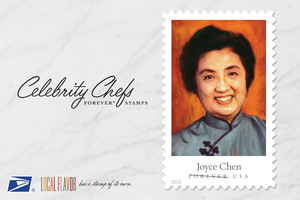
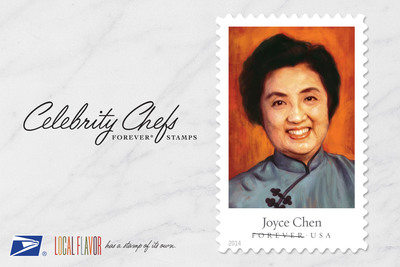
In the December 2014 issue of Bon Appetit, Julia Kramer's recommended that her readers purchase the new U. S. Postal Service's Celebrity Chef Forever stamps. Kramer's full-page column, "The ba Checklist - Everything you need to eat, drink, buy, and mail this month," features a photo of the Joyce Chen Forever stamp, with a caption, "The reason so many Americans eat Chinese. " Thank you Julia Kramer and thank you Bon Appetit. This issue of Bon Appetit also features a recipe of Salt-and-Pepper-Shrimp, which includes Sichuan peppercorns in the recipe. You can purchase Joyce Chen Sichuan Peppercorns online or in select retail stores.
“WRAPPER'S DELIGHT" - BOSTON GLOBE ARTICLE FEATURES DUMPLINGS
Tuesday, November 18, 2014
Devra First, restaurant critic and food writer for the Boston Globe, surveyed dumplings offered at Boston area restaurants in her November 11, 2014 article, “Wrapper’s delight – A dumpling journey around Boston, and the world. ” She said, “Dumplings are a universal language. Nearly every culture has a variation on the theme, from Afghan aushak to Japanese gyoza, Jewish kreplach, Korean mandu, and Vietnamese banh bot loc. ” First found dumplings at 11 Boston-area restaurants: Liquid Art House, Back Bay; Café Polonia, South Boston; Bronwyn, Somerville; Prezza, North End; Pasha, Arlington; Masala, Somerville; Qingdao Garden, Cambridge; Gourmet Dumpling House, Dumpling Café, and Winsor Dim Sum Cafe, Chinatown; and Suya Joint, Rosindale. In Chinatown, she reviewed delicate soup dumplings (xiao long bao) from the Gourmet Dumpling House and the Dumpling Café. At the Winsor Dim Sum Café, First described dumplings served as part of dim sum, which are, “Stuffed with shrimp and chives or pork and peanuts, in wrappers made from rice or wheat, steamed or fried, shaped like half-moons or pleated rounds, they are all delicious. ” Joyce Chen’s introduction of dumplings starting in 1958 at her Cambridge restaurants is part of this story too. Chen’s Peking ravs are now a mainstay item in Chinese restaurants across the U. S.
UTENSILS FOR CHINESE COOKING
Tuesday, November 11, 2014
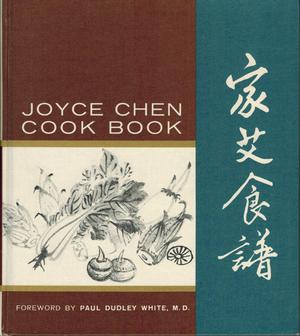
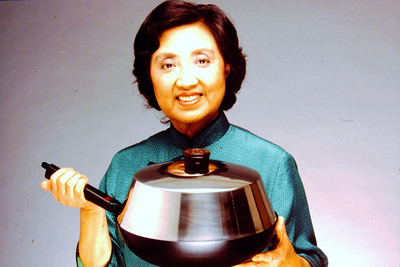
Joyce Chen's devotion to Chinese food extended beyond recipes and ingredients. In her breakthrough 1962 book, "Joyce Chen Cooks," Chen devoted a chapter to utensils for Chinese cooking. She identified three important utensils: ". . . a large sharp knife, a good hardwood cutting board, and a heavy smooth skillet. " She also discussed the use of a large steamer, and described how one can be made with a coffee can. Chen described the Chinese frying pan, ". . . called Wock by the Cantonese (which) is easier for stirring, but not suitable for an electric stove. " Once Chen patented the flat bottom wok with a handle and introduced it to the U. S. market in 1971, the wok could be used on electric stoves. Next to this statement there are drawings of the "Wock," a Wock Cover, and ring to fit Wock for western (gas) stoves. Also recommended by Chen were: large enamled pots for simmering, warming, and serving food; a small and large colander; wooden spoons and spatulas; mixing bowls; chopsticks; and tweezers for, ". . . removing feathers from birds or hair from pork skins. " The chapter featured drawings of the Chinese Cleaver, Chinese Spatula, and Chinese Scoop. Chen said, "My philosophy: We should control the surroundings, not let the surroundings control us. Of course, fine utensils make cooking easier. " She mentioned that she would visit the home of American friends with ingredients but not utensils. She would use whatever they had, but thought that it was more fun to use Chinese utensils.
HENRY KISSINGER AND JOYCE CHEN - 1976 PHOTO FLASHBACK
Wednesday, November 5, 2014
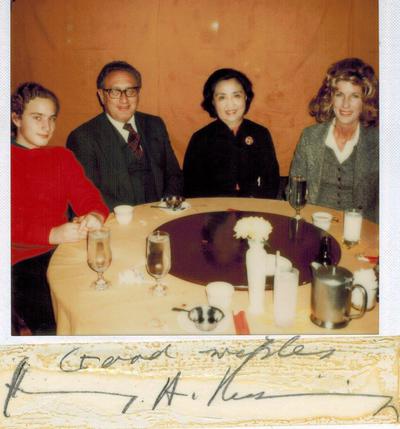
Henry Kissinger was a regular at Joyce Chen's Cambridge restaurant while he earned his AB, MA, and PhD degrees and later taught at Harvard during the 1950s. Decades later, as Secretary of State during the President Nixon's administration, Kissinger spearheaded the 1972 summit among Nixon, Mao Zedong, Communist Party of China Chairman, Zhou Enlai, Chinese foreign policy director. Kissinger's connection to China and Chinese food led to his choice to eat at Joyce Chen's reastaurant in 1976, the night before his wife Nancy had surgery at Massachusett's General Hospital. The "New York Intelligencer" published an article about this meal on February 23, 1976, titled "The K's Seven-Course Pre-Op Celebration. " In this article, Chen's focus on healthier food was evident. She is quoted in saying that she removes the fat between the skin and meat when making Peking duck. The full article, which is not available online, is quoted below: "A sumptuous seven-course Chinese banquet is not the kind of meal that most people have the night before major stomach surgery, but then Nancy and Henry Kissinger aren't most people. The Kissingers and his son, David, by his first marriage, had a rare dinner date in a public restaurant right before Nancy Kissinger when under the knife at Massachusetts General Hospital. The Kissingers chose Joyce Chen's restaruarnt in Cambridge, the best Chinese restaurant north of 72nd Street. "He used to come to my place when he was at Harvard," Madame Chen explained. The madame took over the ordering of the banquet, and arranged lacquered screens to create a semiprivate area and hung a yellow tablecloth over the outside window for security. (A dozen Secret Service men alos at at their own table next to the great man. ) The Kissinger's feast included the special hot platter (lemon purse chicken, spring rolls spareribs, and pea pods); Peking duck served with mandarin pancakes and scallions, plus a sauce Madame Chen imports from China; coral and jade (a shrimp dish); beef with bamboo shoots and black mushrooms; almost-float dessert - and wonton soup, and apparent concession to young David. Kissinger undiplomtaitcally pronounced the Peking duck better than the duck he had had in Peking ("We cut out the fat between the skin and the meat," Madame Chen says). And he asked the cook to come from the kitchen so he could thank him personally. After the Kissingers and their guards left to return to MGH, our reporter, who happened to be dining at a nearby table, inspected the fortune slips left when the fortune cookies had been crumbled. Nancy Kissinger's read: YOU WILL REACH SUCCESS IN YOUR ENDEAVORS. Henry Kissinger's read: MANY A GOOD MAN EXISTS UNDER A SHAPPY HAT. (Or was it the other way around? ) In any case, the next day the surgeons pronounced the operation successful, and Kissinger went to a Boston Bruins game, hatless as usual. " UPDATE - Thursday, November 6, 2014Forty-two years after Henry Kissinger visited Joyce Chen's restaurant in Cambridge,
WICKED LOCAL LEXINGTON AND BEDFORD PAPERS RUN CAMBRIDGE CHRONICLE AND TAB ARTICLE
Monday, November 3, 2014
An edited version of Sara Feijo's October 22, 2014 Cambridge Chronicle and Tab article on Joyce Chen has been published today in the Wicked Local papers in Lexington, and Bedford. These article do a great job publicizing the legacy of Joyce Chen. They also highlight Joyce Chen's her inclusion by the US Postal Service in its Celebrity Chef Forever stamp series. The Lexington article, "A pioneer in Chinese cuisine: Lexington's Joyce Chen be honored on Forever stamp," begins:"Have you ever cooked in a flat-bottom wok? Do you cook Chinese food at home? " For even more detail on Joyce Chen's amazing life, we suggest that you read our website page, "Our Story. "
CANTABRIGIANS JOYCE CHEN AND JULIA CHILD CELEBRATED AT CAMBRIDGE MAYOR'S RECEPTION FOR USPS STAMPS
Wednesday, October 29, 2014
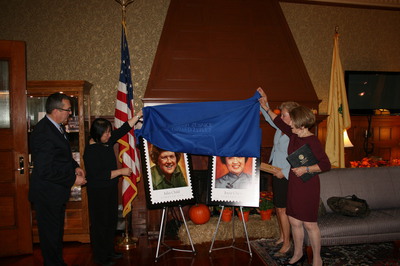
Cantabrigians* Joyce Chen and Julia Child's Celebrity Chef Forever stamps were celebrated today during a reception held in the stately chamber outside the office of David Maher, the mayor of Cambridge MA. These stamps had been released by the Postal Service in a celebration held in Chicago on September 26, 2014. Mayor Maher said, "We celebrate everything that (Joyce Chen and Julia Child) did in their lives, and all that is Cambridge. " Cambridge postmaster Katherine Lydon joined the gathering, and spoke fondly of her husband's memories of Joyce Chen's Cambridge restaurants. The reception was attended by Stephen Chen, president of Joyce Chen Foods, and devotees of Julia Child from the Les Dames d'Escoffier International. Also in attendance were Robin Lapidus, executive director of the Central Square Business Association, several Cambridge politicians, and Jamme Chantler, owner of the Cambridge restaurant, Theolonius Monkfish. Chantler provided an assortment of refreshments, including dumplings. Stephen Chen spoke of his mother's decision to move to Cambridge, a place that he called welcoming an open minded. He said that his mother had friends and relatives who went to Harvard and MIT. They said, "If you come to America, you have to live in Cambridge Massachusetts. " Stephen said that it was the right decision. *Cantabrigians are residents of Cambridge MA and Cambridge UK. The word is derived from Cantebrigge, an early name of Cambridge in the UK.
CAMBRIDGE MAYOR DAVID MAHER'S RECEPTION WILL HONOR JOYCE CHEN
Friday, October 24, 2014
On Wednesday, October 29, 2014, Mayor David P. Maher, of Cambridge, MA, will hold a reception in his office to honor Joyce Chen, who was a long-time resident of Cambridge, and local cultural icon. According the mayor's statement, "Join us to celebrate (Joyce Chen) lifetime of achievements and commemorate the release of the Celebrity Chef stamp series. " This event was publicized in an October 22, 2014 article,"Cambridge's Joyce Chen honored with Forever stamp as pioneer in Chinese cuisine," by Sara Feijo, published in the Cambridge Chronicle and Tab. This reception is one of many honors bestowed on Joyce Chen. She was recently featured in the U. S. Postal Service's Celebrity Chen Forever stamp series.
NPR BLOG POSTING, "IN THE WORLD OF CHEFS, ASIAN WOMAN ARE TURNING UP THE HEAT"
Friday, October 17, 2014
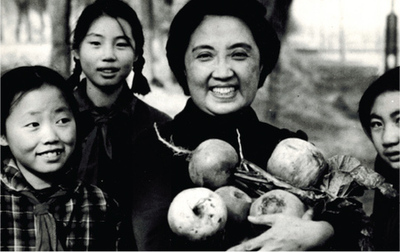
Jean Ho's October 15, 2014 article, "In the World of Chefs, Asian Woman are Turning Up the Heat," makes a strong case that unlike Joyce Chen, some Asian woman are not getting the respect they deserve. Ho states, ". . . there's a glaring absence in this most recent celebration of Asian-American chefs: women. Chinese-American restaurateur Joyce Chen was one of five trailblazing chefs commemorated by a limited edition set of USPS Forever stamps this year, but top honors awarded to contemporary Asian-American female chefs such as Cara Stadler and Anita Lo seem few and far between, perhaps symptomatic of a broader gender bias in the industry. " Ho describes challenges faced by several successfull California-based Asian female chefs: Niki Nakayama of n/naka in west LA, Na Young Ma of Proof Bakery in LA's east side, Thi Tran of Starry Kitchen in West Hollywood, and Vivian Ku, and Moon Lynn Tsai, 28 of Pine & Crane in LA. Nakayama said, "I go home every day, I smell like food — the last thing I feel is glamorous and cool. But I think people enjoy seeing that — chefs that put out a rock-star persona," Nakayama says. And with a small laugh, she adds, "For me, being an Asian woman, it's just a little hard to go there. " The article features this photo of Joyce Chen, courtesy of the Joyce Chen family.
"USING CHOPSTICKS THE PROPER WAY," BY JOYCE CHEN
Wednesday, October 15, 2014
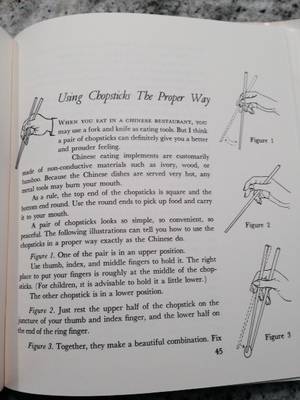
When Joyce Chen published her cookbook, Joyce Chen Cooks in 1962, she wasn’t just thinking about recipes. She introduced U. S. diners to Chinese ingredients, seasonings, utensils, cooking methods, perfect rice, tea, bean sprouts, dipping sauces, and measurements. And, she was gave instructions for “Using Chopsticks the Proper Way. ” Joyce Chen’s Instructions for Using Chopsticks the Proper Way (page. 45 of 1962 edition, Joyce Chen Cooks ) “When you eat in a Chinese restaurant, you may use a fork and knife as eating tools. But I think a pair of chopsticks can definitely give you a better and prouder feeling. ” Use thumb, index, and middle fingers to hold it. The right place to put your fingers in roughly at the middle of the chopsticks. (For children, it is advisable to hold it a little lower. ) Just rest the upper half of the chopstick on the juncture of your thumb and index ringer, and lower the half on the end of the ring finger. Together, they make a beautiful combination. Fix the lower one firmly and move the upper one freely as you wish. Your little finger is used to support the ring finger. One thing that you should not forget it that the two ends of the chopsticks must be even, and not cross, Make them even by tapping the round ends on a plate or on your palm, which is un no sense bad manners. … at first you may be clumsy and slow. Don’t be discouraged. Like any manual skill, it takes practice to manage well. ”
ANTHONY BOURDAIN'S, CNN'S PARTS UNKNOWN, AND JOYCE CHEN'S RECIPE FOR TEA EGGS BOTH FEATURE SHANGHAI
Monday, October 13, 2014
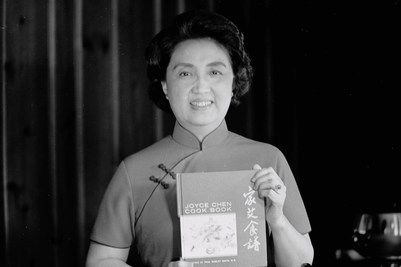
Recently, Anthony Bourdain ate $150 per pound Australian Wagu beef in an episode of CNN’s Parts Unknown . He was exploring the food and culture of Shanghai, as did Joyce Chen her 1962 cookbook, Joyce Chen Cooks with her recipe for Tea Eggs . Parts Unknown In his Shanghai episode, Bourdain said,“Even with the modern China rising – there is still this China. The good old stuff The China you first fell in love with Walk down the street and look in any direction, there’s something to eat. ” Bourdain ate his way through stalls on the street and an uber fancy private club, The House of Roosevelt. He ate dumplings, soups, vegetables, and lots more. He said, “In the 50 and 60s Chinese food was an essential part of being a New Yorker. ” Bourdain marveled at the passion with which the Shanghainese eat. He also said, “Food is the best weapon on earth to make peace. ” Joyce Chen’s Tea Eggs Fifty-two years before Bourdain’s Parts Unknown episode about Shanghai, Joyce Chen brought Tea Eggs, a popular Shanghai appetizer, snack, or side dish to the American palate. In Joyce Chen Cooks , Chen said, “This (Tea Eggs) is a popular picnic items in China and it is wonderful for hors d’oeuvres here. It is served both by rich families and can be bought at street corners, especially in Hangchow, where vendors put the eggs in a small wock (sic) (Chinese frying pan) which is kept warm over a small wood flame. ” Hangchow is a city in China that is about 100 miles from Shanghai. A delicious, savory treat, the Tea Eggs are made by first hard boiling eggs, and then simmering them in a mixture including soy sauce and star anise. According to Chen, the, “… cracks on the egg shell make a beautiful design on egg whites like the cracks on antique porcelain. ” Joyce Chen’s recipe for Tea Eggs has been updates with our Joyce Chen Star Anise, and Joyce Chen Double Black Soy Sauce, which will yield a richer brown color and deeper flavored egg.
DANNY KAYE, GRAHAM KERR, AND JOYCE CHEN - 1971 PHOTO FLASHBACK
Saturday, October 11, 2014
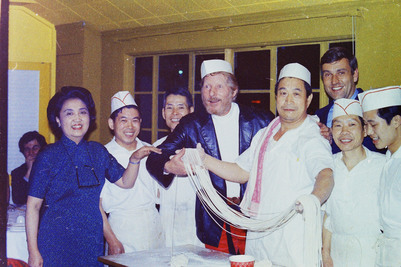
Joyce Chen developed warm friendships with many well known celebrities thanks to her outgoing personality and successful restaurants in Cambridge MA. Taken in 1971 at the Joyce Chen Restaurant at 500 Memorial Drive, this photo captures the strong connection between Joyce Chen and Danny Kaye, and with Graham Kerr. An English cooking personality, Kerr was known for his television show, The Galloping Gourmet, and many cookbooks. According to Stephen Chen, president of Joyce Chen Foods, Danny Kay was in town to conduct the Boston Pops. On Sunday, May 16, 1971, Kaye joined BSO Pops conductor Arthur Fiedler to conduct a program for the Boston Pops Pension Fund Benefit Concert. Earlier on July 13, 1961, Kaye had conducted a Pension Fund Concert at Tanglewood. According to the BSO website, Kaye was coached to conduct by violinist Harry Ellis Dickson, the father of Kitty Dukakis. Kayes musicality, physicality and lifelong dream of conducting was fulfilled by leading the Boston Pops and a number of other orchestras. About Kaye's conducting, Richard Dryer of the BSO wrote: "Of course the audio recording from Tanglewood lacks the important visual dimension of Kaye's performance; Kaye's entire body, and not just his face, was as flexible as rubber. Therefore this download has been lightly edited to remove laughter at sight gags and other unseen antics. It focuses instead on Kaye's verbal virtuosity (he gives us the Chinese for chutzpah ) and on his superb musical instincts - he had a wonderful ear as well as an agile tongue, and he knew how to apply his sense of comic timing to the parallel demands of musical time. The listener will soon recognize that the giants of the podium who admired Kaye's conducting were not just being polite. There was a video of Kaye conducting another orchestra in a similar program, but it has long been out of print and was never commercially transferred to DVD, so this recording is an even more valuable souvenir of a great musician who couldn't read music. " Source: http://www. bso. org/brands/tanglewood/features/from-the-audio-archives/from-the-audio-archives-day-5. aspx